
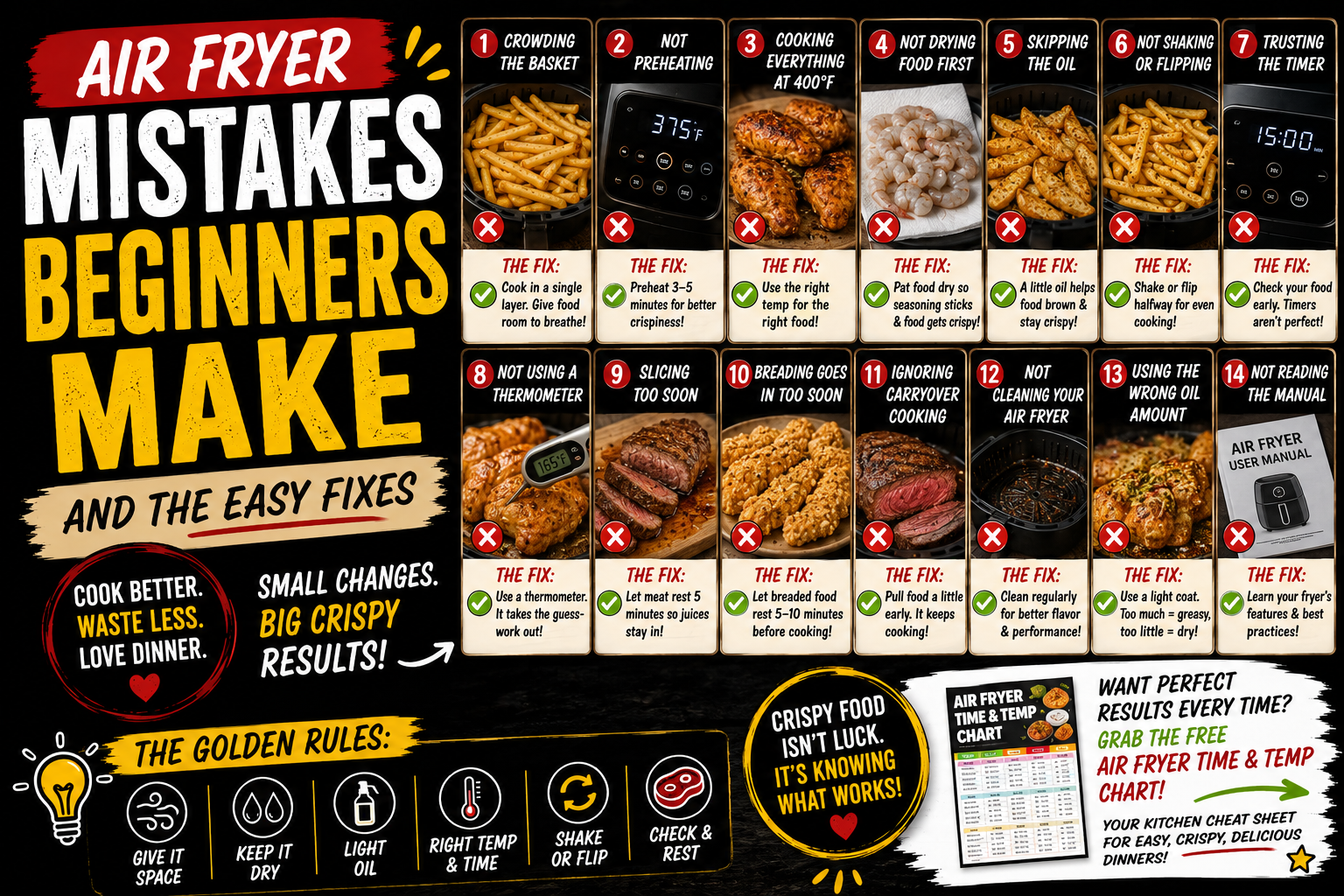
The air fryer seems like it should be impossible to mess up.
That is part of the appeal.
You put food in the basket, push a few buttons, and crispy dinner comes out. No giant oven preheat. No deep fryer. No skillet full of oil. No kitchen drama.
Except, of course, when the chicken is dry, the fries are limp, the shrimp is rubbery, the vegetables are pale, the breading falls off, and the smoke alarm starts offering commentary.
Then suddenly the air fryer feels less like a miracle machine and more like a tiny countertop gremlin with buttons.
The good news is that most air fryer problems are easy to fix. The machine is usually not the issue. It is almost always something simple: too much food in the basket, too much moisture on the food, the wrong temperature, not enough oil, too much oil, no halfway shake, or cooking by hope instead of checking.
Hope is lovely.
It is not a cooking method.
So if you are new to the air fryer, or if you have owned one for a while but still feel like it has a personal grudge against your fries, this guide is for you.
Let’s fix the common mistakes.
Mistake 1: Crowding the Basket
This is the big one.
The air fryer works by moving hot air around the food. That moving air dries the surface, browns the edges, and helps create crisp texture.
But when the basket is packed too full, the hot air cannot reach everything. The top layer gets heat. The bottom layer gets steam. The middle becomes a mysterious potato basement where crispiness goes to disappear.
That is why crowded fries come out limp. It is why breaded chicken gets soft. It is why vegetables steam instead of roast. It is why shrimp cooks unevenly and then acts like rubber.
The fix is simple, even if it is slightly annoying: use less food at one time.
Spread food in a single layer when you can. For fries and vegetables, a little overlap is usually fine if you shake the basket during cooking. For shrimp, chicken tenders, fish nuggets, steak, and breaded foods, give everything more room.
The air fryer basket is not a bowl. It is a tiny hot-air arena.
Let the food have some personal space.
Mistake 2: Forgetting to Preheat
Not every air fryer needs preheating, but many foods benefit from it.
If you put food into a cold air fryer, the food spends the first few minutes warming up with the machine. That can throw off timing, especially for foods that depend on fast surface heat.
Fries may take longer to crisp. Breaded foods may absorb moisture before they start browning. Steak or shrimp may cook less predictably.
The fix is to preheat for a few minutes when crispiness matters.
You do not need to make a ceremony out of it. Three to five minutes is usually enough for many air fryers. Some models preheat automatically. Some do not need much preheat at all. The best approach is to learn your machine.
Yes, I know. “Learn your machine” sounds like something a robot would say before asking for your Wi-Fi password.
But air fryers really do have personalities. Some run hot. Some run gentle. Some are basically dragons with baskets.
Once you know yours, everything gets easier.
Mistake 3: Cooking Everything at 400°F
Air fryer culture has somehow decided that 400°F is the answer to everything.
Frozen fries? 400°F.
Chicken wings? 400°F.
Shrimp? Maybe 400°F.
Steak? Why not 400°F?
Leftover pizza? Obviously 400°F, because apparently we live dangerously.
The problem is that different foods need different heat.
High heat is great for some foods, especially foods that need crisping and can handle it. But lean chicken breast can dry out if blasted too long. Shrimp can go rubbery fast. Steak can overshoot your preferred doneness. Breaded foods can brown too quickly before the inside is cooked.
The fix is to match the temperature to the food.
Chicken breast often does better around 375°F. Shrimp usually cooks beautifully around 375°F to 400°F, but it needs a short time. Steak often benefits from a little more control around 375°F to 380°F. Fries and frozen snacks often like 380°F to 400°F.
The air fryer is not just an on/off crispy box.
It has temperature settings for a reason.
Use them. They are trying to help.
Mistake 4: Not Drying the Food First
Moisture is the enemy of crisp.
This is one of those kitchen truths that sounds too simple to matter, but it matters a lot.
If chicken, shrimp, potatoes, vegetables, or fish go into the air fryer wet, the surface has to dry before it can brown. That extra moisture also creates steam, which softens texture.
This is especially important with thawed frozen shrimp, rinsed vegetables, marinated foods, and anything you want to bread.
Wet shrimp steams. Wet chicken coating slides off. Wet potatoes resist crisping. Wet vegetables roast like they are not emotionally ready.
The fix is easy: pat food dry before seasoning or breading.
Use paper towels or a clean kitchen towel. You do not have to obsess over every molecule of moisture, but get the surface dry enough that oil and seasoning can stick.
Dry surface. Better browning. Happier dinner.
Mistake 5: Skipping the Oil Completely
One of the great selling points of the air fryer is that it uses less oil than deep frying.
That does not mean no oil ever.
A small amount of oil helps seasoning stick, helps the surface brown, and helps breaded foods turn golden instead of dusty. Without a little oil, some foods can come out dry, pale, or chalky.
This is especially true for homemade breaded chicken, fish nuggets, potato wedges, vegetables, and foods with dry coatings.
The fix is a light coating, not a bath.
Toss vegetables or potatoes with a little oil before cooking. Rub chicken or steak with a thin layer of oil before seasoning. Spray breaded foods lightly so the crumbs brown evenly.
The goal is “kissed by oil,” not “rescued from an oil spill.”
A little goes a long way.
Mistake 6: Using Too Much Oil
Yes, we just said not to skip the oil.
Now we need to say not to overdo it.
Welcome to cooking, where two opposite things can be true and somehow both are your responsibility.
Too much oil can make food greasy instead of crispy. It can drip, smoke, pool in the basket, and make seasonings slide around. Some foods already have oil on them, especially frozen fries, frozen nuggets, and many packaged snacks.
The fix is to use oil intentionally.
For frozen fries, you may not need any extra oil at all. For vegetables, a light toss is enough. For breaded foods, a light spray on the surface is usually better than pouring oil over them.
If food comes out greasy, use less oil next time. If it comes out pale or dusty, use a touch more.
This is not failure.
This is calibration.
Very official. Very geeky. Very Gourmet Geek.
Mistake 7: Not Shaking or Flipping Halfway
The air fryer is good, but it is not a tiny kitchen fairy rotating every fry by hand.
Some foods need movement.
Fries, tots, potato wedges, and vegetables usually benefit from a good shake halfway through. That moves pieces around so more surfaces get exposed to hot air.
Chicken tenders, breaded fish, steak, burgers, and delicate foods often need a careful flip instead. Use tongs and be gentle so the coating stays where it belongs.
Shrimp may need a quick shake or flip, depending on size and spacing, but it cooks so fast that you do not want to overdo the fussing.
The fix is to match the move to the food.
Loose and sturdy? Shake.
Coated or delicate? Flip.
Steak? Flip once, then let it be.
This is also how I prefer people to handle me before coffee.
Mistake 8: Trusting the Timer More Than the Food
Recipe times are helpful, but they are not laws of nature.
Air fryers vary. Food sizes vary. Basket shapes vary. Starting temperatures vary. One person’s “medium chicken breast” is another person’s poultry doorstop.
If you follow the timer blindly, you may pull food too early or cook it too long.
The fix is to check the food.
Use the recipe time as a starting point. Then look, feel, and measure when needed. Fries should be crisp, not just hot. Shrimp should be pink and opaque, not curled into tight little rubber bands. Chicken should reach 165°F. Steak should be pulled based on your preferred doneness, not because the timer made a noise.
The beep is a suggestion.
Dinner gets the final vote.
Mistake 9: Not Using a Thermometer
Some people resist thermometers because they feel like a fancy-chef tool.
They are not.
A good instant-read thermometer is one of the most practical kitchen tools you can own. It helps you avoid dry chicken, overdone steak, undercooked burgers, and general dinner uncertainty.
Chicken breast especially benefits from a thermometer because it has a narrow window between juicy and dry. Steak is much easier to control when you know the internal temperature. Even reheating thick leftovers is easier when you can check the center.
The fix is simple: use the thermometer when doneness matters.
For chicken, aim for 165°F. For steak, pull it a few degrees before your final target because it will rise as it rests. For burgers, ground meat needs to be cooked safely. For fish, shrimp, and other seafood, visual cues matter too, but a thermometer can help with thicker pieces.
Guessing is exciting.
Knowing is better.
Mistake 10: Slicing Meat Too Soon
You cooked the chicken perfectly. You pulled the steak at the right temperature. You are proud. You are hungry.
Then you slice it immediately and watch all the juices run onto the cutting board.
We have all done it.
Resting matters, especially for chicken and steak. It gives the juices time to settle back into the meat, which makes the final bite better.
The fix is patience, but only a little.
Let chicken breast rest for about 5 minutes before slicing. Let steak rest for 5 to 8 minutes, depending on thickness. You can use that time to finish a side, make a sauce, set the table, or stand around looking impressed with yourself.
Resting is not wasted time.
It is part of the recipe.
Mistake 11: Breaded Food Goes In Too Soon
Breaded foods need a minute.
If you coat chicken tenders, fish nuggets, or potato croquettes and immediately toss them into the air fryer, the coating may not have time to cling properly. It can slide, flake, or fall off when you flip.
The fix is to let breaded food rest for 5 to 10 minutes before cooking.
That short rest helps the coating hydrate and attach. It gives flour, egg, crumbs, cracker coating, or panko a chance to become one team instead of three separate ingredients having a disagreement.
Then spray lightly with oil and cook in a single layer.
That is how you get crunch instead of crumb confetti.
Mistake 12: Ignoring Carryover Cooking
Food keeps cooking for a little bit after it comes out of the air fryer.
This matters most with steak, chicken, and shrimp.
If you wait until steak is already exactly at your desired final temperature, it may keep rising and overshoot. If you wait until shrimp looks aggressively done, it may become rubbery by the time you plate it. If chicken is left in a hot basket after the timer ends, it can dry out.
The fix is to pull food at the right moment and move it out of the basket.
Do not let finished food sit in the hot air fryer while you wander away to answer a text. The basket stays hot. The food keeps cooking. Dinner gets cranky.
When it is done, take it out.
Simple. Firm. Respectful.
Mistake 13: Not Cleaning the Air Fryer
This is not glamorous, but it matters.
Old crumbs, grease, and stuck-on bits can smoke, smell, and affect the flavor of new food. They can also make food stick or brown unevenly.
If your air fryer smells like last Tuesday’s fish nuggets every time you turn it on, it may be asking for help.
The fix is regular cleaning.
Let the basket cool, then wash it according to your model’s instructions. Wipe out crumbs. Check for greasy buildup. Keep the heating area clean if your manual allows it.
Nobody enjoys cleaning the air fryer.
But nobody enjoys smoky mystery flavor either.
Choose your hardship.
Mistake 14: Not Reading Your Air Fryer’s Manual
I know.
Manuals are not fun.
They are usually written in a tone that suggests a committee of cautious robots wants you to enjoy potatoes responsibly.
But your specific air fryer may have rules about preheating, basket placement, oil sprays, maximum fill lines, cleaning, accessories, and cooking modes. Knowing those rules can save you frustration.
The fix is to skim the manual once.
You do not have to frame it. Just learn the basics. Does it preheat automatically? Are aerosol sprays discouraged? Can parts go in the dishwasher? Does it have a max fill line? Does it run hot?
A five-minute skim can prevent a lot of crispy-food heartbreak.
The Easy Air Fryer Fix Formula
When something goes wrong in the air fryer, ask a few simple questions.
Was the basket too crowded? Was the food wet? Was the temperature too high or too low? Did it need oil? Did it have too much oil? Did it need shaking or flipping? Did you check it early enough? Did it need to rest?
Most problems live somewhere in those answers.
That is the good news. Air fryer cooking gets better fast because the fixes repeat across foods.
The same single-layer rule helps fries, shrimp, tenders, wings, and vegetables.
The same pat-dry rule helps chicken, seafood, potatoes, and breaded foods.
The same thermometer habit helps chicken, steak, burgers, and fish.
Learn the patterns, and suddenly the air fryer feels a lot less mysterious.
The Big Takeaway
The air fryer is easy, but it is not automatic perfection.
It still needs space, timing, temperature, a little oil, a little movement, and a little common sense.
Do not crowd the basket. Pat food dry. Use the right heat. Shake or flip when needed. Use a thermometer for meat. Let steak and chicken rest. Give breaded foods a few minutes before cooking. Clean the basket once in a while so dinner does not taste like ghosts of meals past.
That is the whole beginner air fryer lesson.
Once you get those basics, everything improves. Fries get crispier. Chicken stays juicier. Shrimp stays tender. Breaded foods actually crunch. Vegetables roast instead of steam.
And dinner gets a lot less weird.
If you want a printable guide for air fryer times, temperatures, and quick fixes for chicken, steak, shrimp, fries, and more, grab the free Gourmet Geek Air Fryer Time & Temp Chart. It is the kitchen cheat sheet that helps beginners skip the sad-food stage and get straight to the crispy, juicy, “hey, this actually worked” part.