
The air fryer is supposed to make dinner easier.
That is the whole promise.
Put food in the basket, set the time and temperature, and out comes crispy, juicy, weeknight-friendly food without a lot of fuss.
And when it works, it really works.
Chicken comes out juicy. Fries get crispy. Shrimp cooks in minutes. Steak becomes a shockingly respectable dinner without smoke, splatter, or the emotional commitment of dragging out the cast iron pan.
But when the timing is off?
That is when things get weird.
Chicken breast turns dry. Shrimp turns rubbery. Fries come out limp. Steak overshoots from medium-rare to “well, at least there’s sauce.” Chicken tenders look golden on the outside but are not quite done in the middle.
The air fryer is fast, which is great right up until it is fast in the wrong direction.
That is why a simple air fryer time and temperature guide is so useful. Not because cooking needs to become complicated, but because a few reliable starting points can save dinner before dinner gets dramatic.
Think of this as your friendly kitchen cheat sheet.
Not a law book.
Not a sacred scroll.
Just a practical guide to help you stop guessing and start getting better results.
Why Air Fryer Times Vary
Before we get into the numbers, we need to talk about one important truth.
Air fryers are not all the same.
Some run hot. Some run gentle. Some have small baskets. Some have big drawer-style baskets. Some are toaster-oven style. Some preheat automatically. Some act like tiny countertop dragons and finish everything two minutes before you expected.
Food varies too.
A thick chicken breast takes longer than a thin one. Jumbo shrimp takes longer than small shrimp. Steak thickness matters. Frozen fries vary by cut and brand. Breaded foods cook differently than unbreaded foods.
So the times in this guide are starting points. They are the “begin here” numbers, not the “walk away forever” numbers.
The real goal is to learn the pattern: good temperature, reasonable time, enough space, halfway shake or flip, and a quick doneness check near the end.
That is where air fryer confidence comes from.
Not magic.
Just a little kitchen geekery.
The Quick Air Fryer Time and Temperature Guide
Here are practical starting points for the foods people ask about most: chicken, steak, fries, shrimp, and breaded favorites.
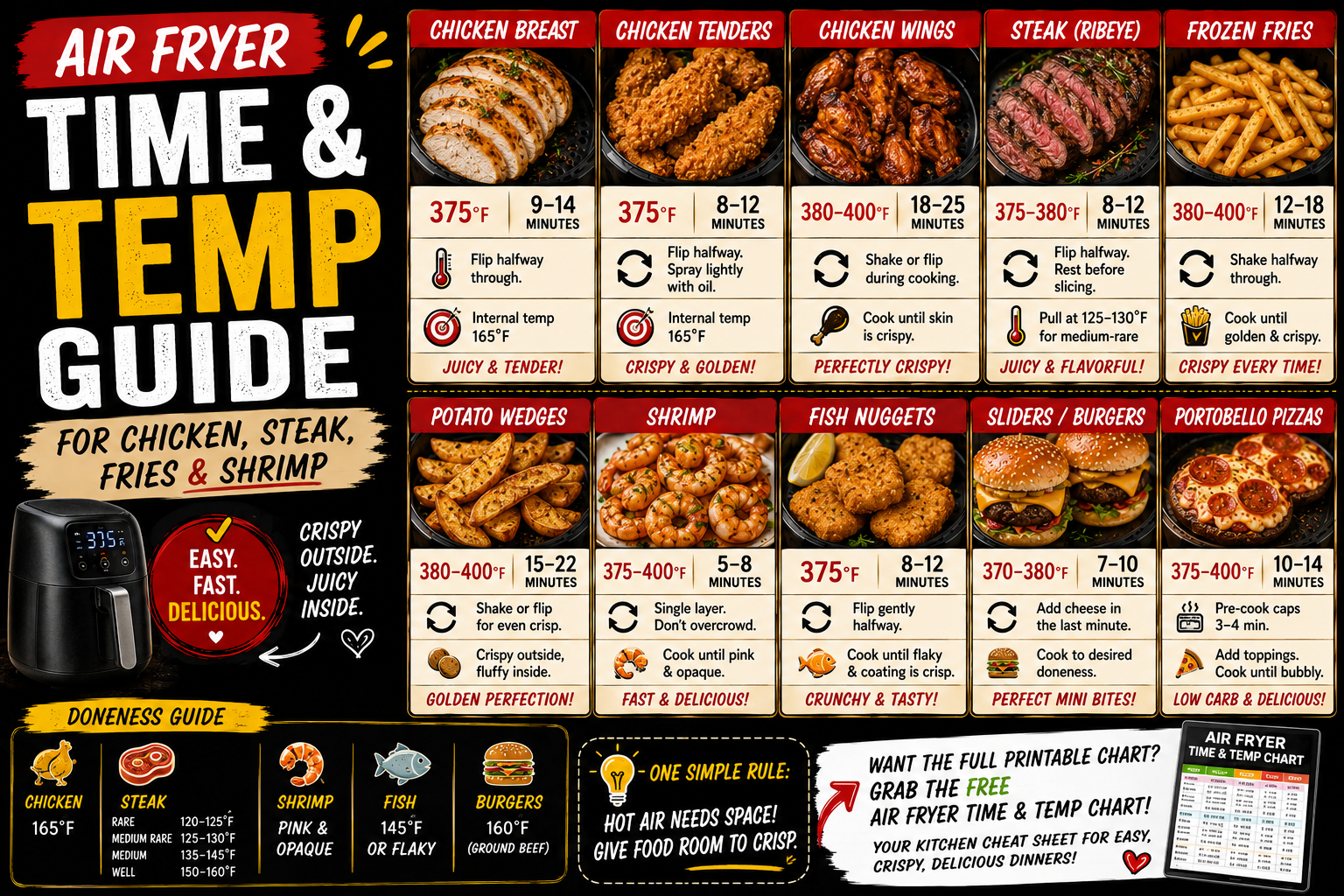
For boneless chicken breast, start around 375°F and cook for about 9 to 14 minutes, depending on thickness. Flip halfway through and check that the thickest part reaches 165°F.
For chicken tenders, start around 375°F and cook for about 8 to 12 minutes. Flip halfway through, spray breaded spots lightly with oil if needed, and cook until the chicken reaches 165°F.
For chicken wings, start around 380°F to 400°F and cook for about 18 to 25 minutes, shaking or flipping during cooking. Wings need time for the skin to render and crisp, so do not pull them the second they are merely hot.
For ribeye or similar steak, start around 375°F to 380°F and cook for about 8 to 12 minutes for a 1-inch steak, flipping halfway through. Pull based on your preferred doneness and let the steak rest before slicing.
For skirt steak or thinner steak cuts, start around 380°F and check early. Thin cuts move quickly, and nobody wants to accidentally turn steak night into beef jerky night.
For frozen fries, start around 380°F to 400°F and cook for about 12 to 18 minutes, shaking halfway through. Thin fries cook faster. Thick wedges and steak fries may need longer.
For potato wedges or potato skin wedges, start around 380°F to 400°F and cook for about 15 to 22 minutes, depending on size. Give them space and shake or flip so the edges can crisp.
For raw shrimp, start around 375°F to 400°F and cook for about 5 to 8 minutes. Spread shrimp in a single layer and pull them as soon as they are pink and opaque.
For cod fish nuggets or breaded fish pieces, start around 375°F and cook for about 8 to 12 minutes, flipping gently halfway through.
For mini cheeseburger sliders or small burger patties, start around 370°F to 380°F and cook for about 7 to 10 minutes, depending on thickness. Add cheese near the end so it melts without making a basket mess.
For portobello pepperoni pizzas, pre-cook the mushroom caps briefly to release moisture, then add toppings and cook until the cheese is melted and bubbly.
That is the quick version.
Now let’s make it useful.
Air Fryer Chicken Breast
Chicken breast is one of the easiest foods to overcook in the air fryer because it is lean and not especially forgiving.
A chicken thigh will usually give you some grace.
A chicken breast keeps receipts.
For juicy chicken breast, start by making the thickness more even. If one end is much thicker than the other, pound it lightly or slice the breast into thinner cutlets. This helps the whole piece cook at the same pace.
Pat the chicken dry, rub it with a little oil, and season it well. A basic mix of salt, pepper, garlic powder, onion powder, and smoked paprika works beautifully.
Cook at 375°F, flip halfway through, and start checking near the low end of the time range. The safest way to avoid dry chicken is to use an instant-read thermometer. Chicken breast should reach 165°F in the thickest part.
Then let it rest for about 5 minutes before slicing.
That little rest is not optional if you want the juices to stay in the chicken instead of running all over the cutting board like they are trying to escape.
Air Fryer Chicken Tenders
Chicken tenders are air fryer comfort food royalty.
They are quick, dippable, family-friendly, and perfectly suited for a crispy coating. But breaded tenders need a little technique if you want the coating to stay on and brown properly.
Cook chicken tenders at about 375°F for 8 to 12 minutes, flipping halfway through. If they are breaded, spray the top lightly with oil before cooking, then spray any dry spots after flipping.
Do not stack them. Breaded foods need space or the coating softens and falls off.
If you are making cracker-crusted chicken tenders, press the crumbs onto the chicken firmly and let the breaded pieces rest for 5 to 10 minutes before air frying. That helps the coating cling.
The chicken is done when the thickest part reaches 165°F and the coating is golden and crisp.
Serve with honey mustard, ranch, barbecue sauce, buffalo sauce, or whatever sauce keeps peace at the table.
Sauce diplomacy is real.
Air Fryer Steak
Air fryer steak sounds wrong until you try it.
No, it will not give you the exact same crust as a blazing cast iron skillet. Cast iron still wins the dramatic steakhouse performance category.
But the air fryer can make a very good steak with less smoke, less splatter, and much less chaos.
For a 1-inch ribeye, sirloin, or similar steak, cook around 375°F to 380°F for about 8 to 12 minutes, flipping halfway through. The exact time depends on thickness, starting temperature, and how done you like your steak.
A thermometer helps tremendously here.
For medium-rare, many cooks pull steak around 125°F to 130°F and let it rest. For medium, pull closer to 135°F to 140°F. The temperature usually rises a little as the steak rests, so do not wait until it is already over the finish line.
Let steak rest for 5 to 8 minutes before slicing.
This is the perfect time to make it feel special with garlic butter, chimichurri, or a quick pan-free steakhouse sauce.
A little green sauce over sliced steak does wonders. It says, “Yes, this was on purpose.”
Air Fryer Frozen Fries
Frozen fries are one of the air fryer’s greatest hits.
They are also one of the easiest foods to accidentally ruin by overcrowding the basket.
For frozen fries, start around 380°F to 400°F and cook for about 12 to 18 minutes, shaking halfway through. Thin shoestring fries may cook faster. Thicker crinkle cuts, steak fries, and wedges may need longer.
The biggest mistake is piling too many fries in the basket. When fries are crowded, they steam instead of crisp. The top layer gets color, the bottom layer gets sad, and the middle enters a foggy potato identity crisis.
Spread fries out as much as you can. A little overlap is fine, especially if you shake them, but a deep pile is asking for limp fries.
Season after cooking while the fries are hot. That is when salt and spices stick best.
If the timer goes off and the fries are hot but not crisp, shake the basket and cook a few more minutes. Hot is not the same as crispy.
This is an important emotional boundary.
Air Fryer Potato Wedges and Potato Skins
Potato wedges, potato skin wedges, and thicker potato cuts need a little more time than standard frozen fries, but they can be fantastic in the air fryer.
Start around 380°F to 400°F and cook for about 15 to 22 minutes, depending on size and thickness.
The best wedges have space in the basket, a light coating of oil, and enough time for the edges to get golden. Shake or flip them during cooking so more surfaces get exposed to hot air.
If homemade wedges are not browning, they may be too wet or too crowded. Pat them dry before seasoning, use a little oil, and give them room.
Potatoes are patient.
Crispy potatoes are a little more demanding.
Worth it, though.
Air Fryer Shrimp
Shrimp is one of the fastest air fryer dinners you can make.
It is also one of the fastest foods to overcook.
For raw shrimp, cook around 375°F to 400°F for about 5 to 8 minutes. Smaller shrimp may need less time. Jumbo shrimp may need a little more.
The shrimp is done when it turns pink, opaque, and curls into a loose C-shape. If it curls tightly into an O-shape and feels bouncy, it probably went too far.
Pat thawed shrimp dry before seasoning. Wet shrimp steams. Dry shrimp cooks more cleanly and holds seasoning better.
Toss shrimp with a little oil and seasoning before cooking. Cajun seasoning, garlic powder, smoked paprika, lemon pepper, or chili-lime seasoning all work nicely.
Finish with lemon, herbs, garlic butter, or sauce after cooking. Do not start shrimp in a puddle of butter unless you enjoy cleaning and regret.
Oil before. Butter after.
That is the shrimp move.
Air Fryer Fish Nuggets
Breaded fish nuggets, especially cod nuggets, can be excellent in the air fryer.
Cook around 375°F for about 8 to 12 minutes, flipping gently halfway through. Use a light oil spray so the coating browns evenly.
Fish is more delicate than chicken, so be careful when flipping. If the coating sticks, give it another minute before trying again or use a thin spatula.
The fish should be flaky and cooked through, and the coating should be crisp.
Serve with tartar sauce, lemon, slaw, fries, or tuck the nuggets into tacos.
Air fryer fish taco night is a very reasonable life choice.
Air Fryer Burgers and Sliders
Small burger patties and sliders cook quickly in the air fryer and can be a fun weeknight dinner.
For mini cheeseburger sliders, start around 370°F to 380°F and cook for about 7 to 10 minutes depending on thickness. Add cheese near the end so it melts without overcooking the burger.
Ground beef should be cooked safely, so use a thermometer if you are unsure.
Give the patties a little space in the basket. If they are too close together, they can steam or cook unevenly.
Serve with slider buns, pickles, lettuce, tomato, onion, burger sauce, and crispy fries or potato wedges.
Small burgers feel festive.
This is not science, but it is true.
Air Fryer Portobello Pepperoni Pizzas
Portobello pepperoni pizzas are one of those air fryer recipes that feels like a clever little kitchen trick.
Mushrooms hold moisture, so the key is to pre-cook the caps briefly before adding sauce and cheese. That helps prevent a watery pizza situation.
Clean the mushroom caps, remove the stems, and scrape out the gills if you prefer. Pat them dry, then air fry for a few minutes to release moisture. Blot if needed, then add sauce, cheese, pepperoni, and seasoning.
Return to the air fryer until the cheese melts and the edges look bubbly.
This one is less about an exact universal time and more about watching for melted, happy cheese.
Happy cheese is a valid doneness cue.
How to Adjust Time and Temperature
Once you understand the patterns, adjusting air fryer times gets easier.
Thicker food usually needs more time or slightly lower heat.
Smaller food cooks faster.
Frozen food needs more time than fresh food.
Wet food needs drying first.
Breaded food needs light oil.
Crowded food needs more space, not just more minutes.
If the outside browns before the inside is cooked, lower the temperature slightly and cook a little longer.
If the food is cooked through but pale or soft, raise the temperature near the end, add a light oil spray if appropriate, or give it more space.
If food is drying out, start checking earlier and consider lowering the heat slightly.
The air fryer is quick, so small adjustments matter.
A minute or two can be the difference between juicy shrimp and seafood pencil erasers.
The Doneness Checks That Matter
Timers are helpful, but doneness matters more.
Chicken should reach 165°F.
Ground beef should be cooked safely, especially for burgers.
Steak should be pulled based on your preferred doneness and rested before slicing.
Shrimp should be pink, opaque, and tender.
Fries should be crisp, not just hot.
Breaded foods should be golden outside and cooked through inside.
Vegetables should be browned at the edges if you want roasted texture, not just softened.
The air fryer beep is not the boss.
It is more like a polite suggestion from a small appliance.
You still get to check dinner.
The Single-Layer Rule
The single-layer rule deserves its own reminder because it fixes so many air fryer problems.
Hot air needs space to move around the food. If the basket is too crowded, food traps steam and cooks unevenly.
That is why fries get limp, shrimp gets rubbery, vegetables get soft, and breaded foods lose their crunch.
When crispiness matters, spread food out. Cook in batches if needed. Shake loose foods like fries and vegetables. Flip delicate or breaded foods carefully.
It feels slower at first, but it usually saves you from having to rescue a bad batch later.
Two crispy batches beat one crowded disappointment.
That sounds like something that should be embroidered on an apron.
Quick Troubleshooting Guide
If your food is soggy, the basket was probably too crowded or the food was too wet.
If your food is pale, it may need a little oil, more time, or a hotter finish.
If your chicken is dry, it cooked too long or the pieces were uneven.
If your shrimp is rubbery, it overcooked.
If your steak overshot the doneness you wanted, start checking earlier and pull it before the final target.
If your fries are limp, spread them out and shake halfway through.
If your breading fell off, dry the food first, press the crumbs on firmly, rest before cooking, spray lightly, and flip gently.
If your vegetables steamed instead of roasted, use less in the basket and give them room.
Most air fryer problems are not mysterious.
They are usually space, moisture, time, or temperature.
Four tiny gremlins. Very fixable.
The Big Takeaway
A good air fryer time and temperature guide does not replace paying attention.
It gives you a smart place to start.
Chicken breast likes moderate heat and a thermometer. Steak needs control and a rest. Fries need space and a shake. Shrimp needs speed and restraint. Breaded foods need dry surfaces, light oil, and a gentle flip.
Once you know those patterns, the air fryer becomes much easier to trust.
Dinner gets faster. Food gets crispier. Chicken stays juicier. Shrimp stops bouncing. Fries stop disappointing everybody.
That is the goal.
And if you want this guide in a printable version you can keep in the kitchen, grab the free Gourmet Geek Air Fryer Time & Temp Chart. It is the simple cheat sheet for chicken, steak, fries, shrimp, tenders, fish, burgers, and more — because guessing is fun for game night, not dinner.