
There are few kitchen disappointments as specific as breading betrayal.
You did the work. You seasoned the food. You set up the flour, egg, crumbs, maybe even crushed crackers because you were feeling inspired. You carefully coated the chicken tenders, fish nuggets, cutlets, or potato croquettes.
Everything looked promising.
Then you opened the air fryer and found half the coating stuck to the basket, a few bald patches on the chicken, and a sad little pile of crumbs underneath like the breading packed its bags and left.
Rude.
The air fryer can make beautifully crispy breaded foods, but it is not quite the same as deep frying. In hot oil, the coating sets quickly from all sides. In an air fryer, the food is sitting in a basket while hot air moves around it. That means the coating needs to be properly attached before the cooking starts.
The good news is that keeping breading on your food is not complicated. It is mostly about moisture, order, pressure, resting time, oil, and space.
Very official. Very crispy. Very worth it.
Why Breading Falls Off in the Air Fryer
Breading falls off when it never really stuck in the first place.
That may sound obvious, but it is the heart of the problem.
If the food is too wet, the first layer slides around. If there is too much flour, the egg layer clumps instead of gripping. If the crumbs are barely pressed on, the air fryer fan can loosen them. If the breaded food goes straight into the basket without resting, the coating may not have time to settle.
Then comes the flip.
You lift the piece with tongs, the coating catches on the basket, and there it goes.
Crunch dreams. Gone.
The fix is to build a coating that acts like it belongs there.
Start With Dry Food
This is the first and most important step.
Before anything gets breaded, pat it dry.
Chicken, fish, shrimp, vegetables, and even potato croquettes all need a surface that can hold onto the coating. If the surface is wet, the breading slides. Wet food also creates steam, which softens the coating and makes it more likely to fall off.
Use paper towels or a clean kitchen towel and dry the surface well. You do not need to obsess, but the food should not be dripping, shiny-wet, or sitting in a puddle.
This is especially important with thawed frozen foods. Frozen fish, shrimp, and chicken can release a lot of moisture as they thaw. If you bread them while they are still damp, the coating is already in trouble.
Dry food gives the breading a chance.
Wet food makes the breading question its career choices.
Use the Three-Layer Method
For most breaded air fryer foods, the classic three-layer method works best.
First comes a light coating of flour. Then egg. Then crumbs.
The flour gives the egg something to hold onto. The egg gives the crumbs something sticky to grab. The crumbs create the crispy outside.
Each layer has a job. When one layer is skipped or overdone, the coating gets less reliable.
The key word with flour is light. You want a thin dusting, not a snowstorm. Shake off the extra before dipping into the egg. Too much flour can create dry patches or a gummy layer that separates from the food.
The egg should coat the surface, but you do not want the food dripping like it just climbed out of a swimming pool. Let the excess drip off before moving to the crumbs.
Then press the crumbs on firmly.
Do not just roll the food around and hope for the best. Press. Pat. Encourage. Let those crumbs know this is a long-term relationship.
Pick the Right Crumbs
Different coatings behave differently in the air fryer.
Fine breadcrumbs can work, but they sometimes cook up a little flat. Panko gives you more crunch because the pieces are larger and lighter. Crushed crackers are excellent for chicken tenders because they bring flavor and texture. Crushed cornflakes can be very crispy. Parmesan mixed into crumbs can add flavor, but too much cheese can brown quickly, so use some restraint.
For fish nuggets, panko or cracker crumbs both work well. For chicken tenders, crushed butter crackers, saltines, or panko are all strong options. For potato croquettes, a finer crumb can help create an even coating, but panko gives more crunch.
The best coating often has texture. A few bigger bits mixed with smaller crumbs gives the air fryer something to crisp.
Think jagged, not dusty.
Jagged is where crunch lives.
Season Every Layer, But Do Not Overdo It
Breading can taste bland if all the seasoning sits on the outside.
A better approach is to season the food first, then add a little seasoning to the flour or crumbs. That way the flavor is not just sitting on the surface hoping someone notices.
For chicken tenders, garlic powder, onion powder, paprika, salt, and black pepper work beautifully. For fish nuggets, try lemon pepper, garlic powder, paprika, and a little salt. For potato croquettes, garlic, onion, pepper, parsley, and Parmesan can be lovely.
But be careful with salty crackers, seasoned breadcrumbs, or seasoning blends that already contain salt. It is very easy to go from “nicely seasoned” to “why does this tender taste like it joined the Navy?”
Taste your crumbs if you are unsure.
Yes, I am giving you permission to taste cracker crumbs. This is important research.
Press the Coating On
This step matters more than people think.
Once the food is in the crumbs, press the coating onto all sides. Use your fingers or the palm of your hand to gently pack the crumbs into the egg layer.
You are not trying to smash the food. You are trying to make contact.
For chicken tenders, press along the top, bottom, sides, and ends. For fish nuggets, be gentle but thorough. For croquettes, roll and press lightly so the coating surrounds the whole piece.
If a crumb coating is just loosely sitting on the surface, the air fryer can blow it around or loosen it when the food is flipped.
Pressed crumbs stay put better.
Loose crumbs become basket confetti.
Let the Breaded Food Rest
This is the secret step.
After breading, let the food rest for 5 to 10 minutes before air frying.
That little pause gives the coating time to hydrate and cling. The flour, egg, and crumb layers start to act like one coating instead of three separate ingredients stacked on top of each other.
If you have time, resting on a wire rack is ideal because air can circulate underneath. A plate is fine too. Just avoid stacking the breaded pieces.
This is also a good time to preheat the air fryer, clean up the breading station, or make a dipping sauce.
Resting may feel like a delay, but it saves you from the much greater delay of staring into the basket wondering why your chicken tender is now wearing a crumb bikini.
Use a Light Oil Spray
Breaded foods need a little oil in the air fryer.
Without oil, the coating can stay pale, dry, or powdery. With a light spray, the crumbs brown and crisp much better.
The goal is even coverage. Spray the top side before cooking, then flip and spray the other side if needed. Pay attention to any dry floury spots. Those areas will stay pale unless they get a little oil.
Use a refillable oil sprayer if you have one, or follow your air fryer manufacturer’s guidance on sprays. Some aerosol sprays can leave residue on certain baskets, so it is worth checking your manual.
This is one of those rare moments where the manual is useful and not just a tiny booklet of countertop anxiety.
A little oil helps the coating crisp.
Too much oil can make it greasy.
Light and even is the move.
Give Everything Space
Breaded food needs room in the basket.
If the pieces are touching or stacked, the coating can soften where they meet. It can also tear when you try to separate or flip them. The food may steam instead of crisping, which makes the coating more fragile.
Place breaded chicken tenders, fish nuggets, cutlets, or croquettes in a single layer with a little space between each piece.
If you need to cook in batches, cook in batches.
I know. Batches are not glamorous.
But neither is naked chicken.
Give the coating room to crisp and it will behave much better.
Flip Gently
The halfway flip is where many coatings meet their destiny.
Use tongs or a thin spatula, and be gentle. If the food seems stuck, do not yank it. Let it cook another minute or loosen it carefully from the edge.
A light oil spray before cooking can help reduce sticking. So can making sure the basket is clean before you start.
When flipping breaded food, grab the food itself, not just the coating. Support it as much as you can. For delicate fish nuggets or croquettes, a small spatula may work better than tongs.
This is not the time for aggressive kitchen energy.
Save that for opening stubborn pickle jars.
Best Foods for Air Fryer Breading
The breading method works especially well for chicken tenders, chicken cutlets, fish nuggets, pork cutlets, shrimp, mozzarella-style bites, vegetables, and potato croquettes.
Chicken tenders are probably the easiest place to start because they are sturdy and cook quickly. Cod fish nuggets are another great option because the mild fish pairs nicely with a crisp coating and a dipping sauce. Potato croquettes are a little more delicate, but when they work, they are crispy outside, soft inside, and dangerously snackable.
Once you learn the method, the pattern stays the same.
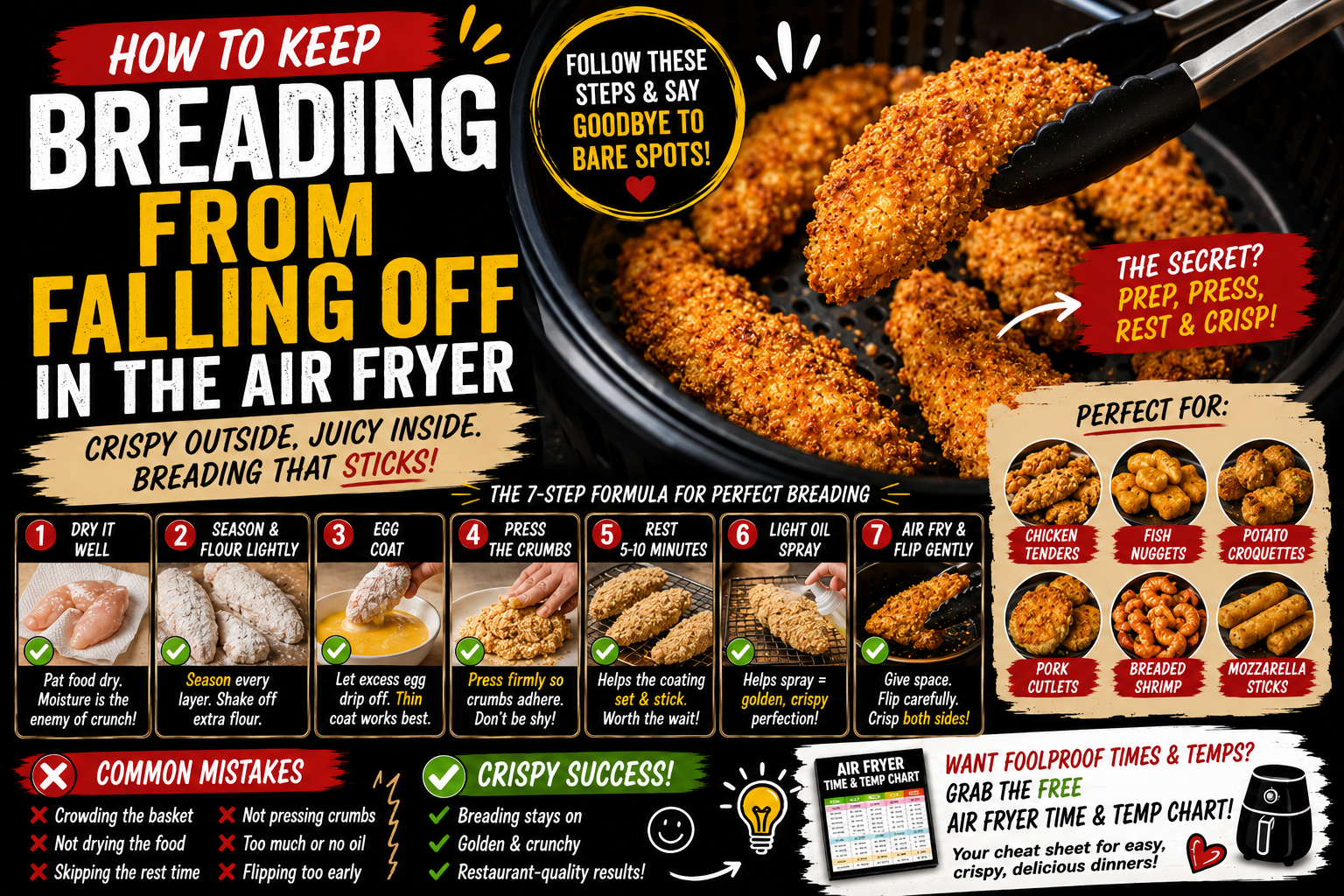
Dry the food. Flour lightly. Dip in egg. Press into crumbs. Rest. Spray. Air fry in a single layer. Flip gently.
That is the breading system.
Not complicated. Just particular.
Troubleshooting: What Went Wrong?
If the coating fell off in sheets, the food may have been too wet or the flour layer may have been too thick. Pat the food dry and use only a light dusting of flour next time.
If the crumbs fell off in loose patches, they probably were not pressed on firmly enough or the breaded food did not rest before cooking.
If the coating stuck to the basket, use a light oil spray and make sure the basket is clean. Let the food cook a little longer before trying to flip if it resists.
If the coating was pale and dusty, it needed more oil. Spray lightly and evenly, especially over dry crumb spots.
If the coating browned too fast, the air fryer may be too hot or the crumbs may include ingredients that brown quickly, like cheese or sugary seasonings. Lower the temperature slightly.
If the inside was cooked but the outside was soft, the basket may have been overcrowded or the food released too much moisture. Cook in a single layer with more space.
If the breading tasted bland, season the food before breading and add a little seasoning to the crumbs.
Most breading problems are fixable. The coating is not being dramatic for no reason.
Well, maybe a little.
But it can be trained.
The Big Takeaway
Breading stays on better when it has something to hold onto.
Start with dry food. Use a light flour layer. Dip in egg. Press the crumbs on firmly. Let the coating rest for a few minutes. Spray lightly with oil. Cook in a single layer. Flip gently.
That is how you keep the crispy outside where it belongs: on the food, not scattered across the bottom of the basket.
Once you get this method down, air fryer breaded foods become much more reliable. Country chicken tenders, cod fish nuggets, cracker-crusted cutlets, potato croquettes — all of them use the same basic logic.
Grip. Rest. Space. Crisp.
That is the breading rule.
And if you want a printable air fryer timing guide for chicken tenders, fish, fries, shrimp, steak, and more, grab the free Gourmet Geek Air Fryer Time & Temp Chart. It is the kitchen cheat sheet that helps keep dinner crispy, juicy, and fully dressed.