The air fryer is a wonderful little machine, but it does have one boundary.
It does not like crowds.
This is disappointing news because most of us want to dump the whole bag, tray, bowl, or pile of food into the basket and be done with it. Fries, wings, shrimp, chicken tenders, potato wedges — if the basket can physically hold it, it feels like we should be allowed to cook it.
And technically, yes, you can.
But there is a difference between food that fits in the air fryer and food that cooks well in the air fryer.
That difference is usually the single-layer rule.
If you have ever pulled out a basket of limp fries, soggy chicken tenders, pale potato wedges, rubbery shrimp, or wings that somehow managed to be dry and soft at the same time, overcrowding may have been the culprit.
The air fryer is not magic. It is hot air. And hot air needs room to move.
Once you understand that, your air fryer food gets a lot better.
Why the Single-Layer Rule Matters
An air fryer works by circulating hot air around the food. That moving air is what helps the surface dry, brown, and crisp.
The key word there is around.
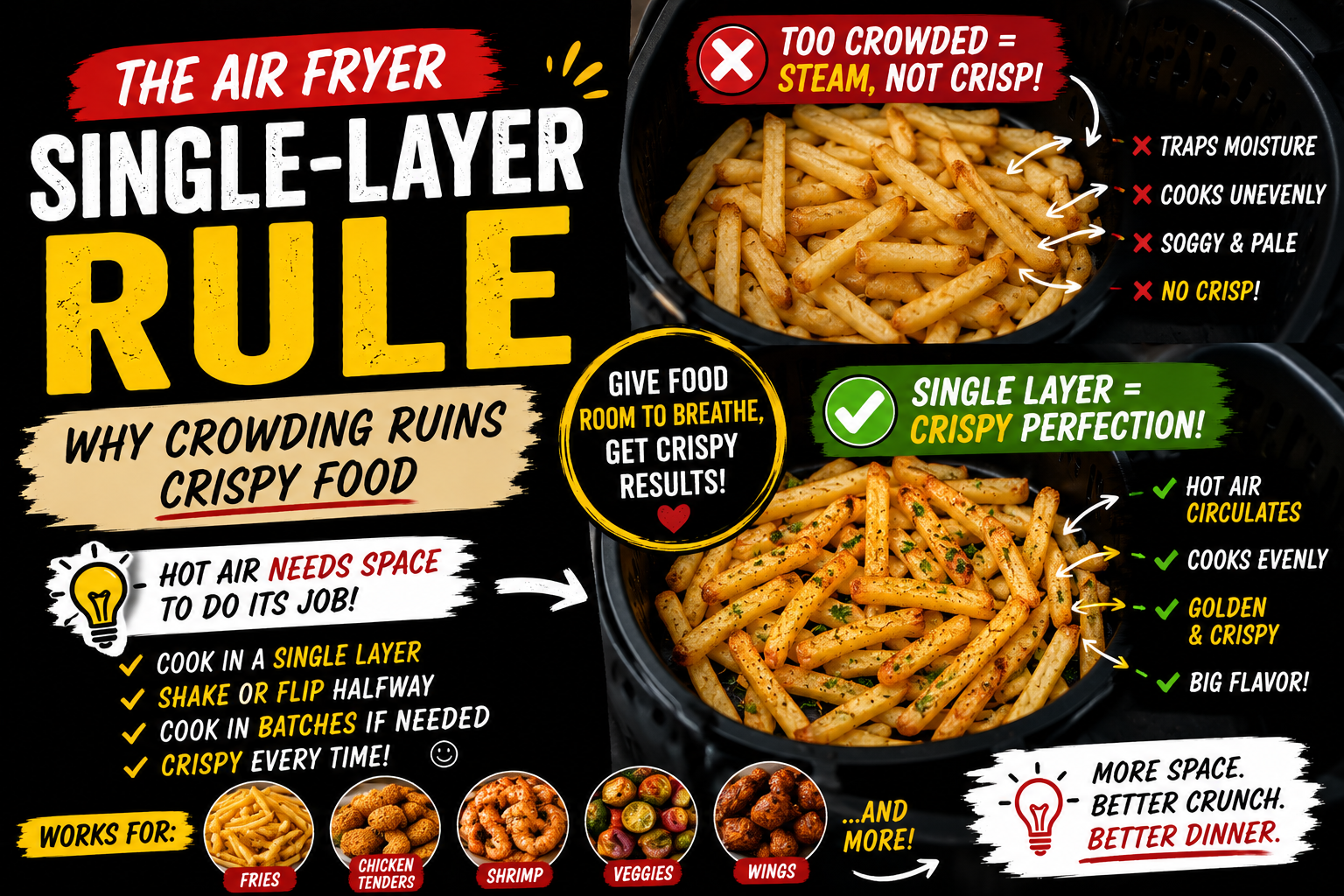
If hot air can move around the food, you get better texture. If the food is piled up, stacked, smashed together, or hiding underneath another layer, the air cannot reach every surface. Instead of crisping, the food starts steaming.
That is why a crowded basket often gives you weird results. The top pieces may brown. The bottom pieces may stay soft. The middle pieces may cook unevenly. And everything comes out a little less exciting than promised.
It is not that the air fryer failed.
It is that we asked it to perform a miracle inside a potato traffic jam.
What Happens When Food Is Crowded
Crowded food traps moisture.
This is especially true with frozen foods, raw shrimp, vegetables, and breaded chicken. As food heats up, it releases steam. When there is enough open space, that moisture moves away and the surface can crisp. When everything is jammed together, the steam gets trapped between the pieces.
Now your fries are taking a steam bath. Your chicken coating is getting damp. Your shrimp are cooking unevenly. Your vegetables are softening instead of roasting.
And then we stand there looking into the basket like, “Why are you like this?”
The air fryer is not being difficult. It just needs airflow.
Airflow is the whole game.
The Basket Is Not a Bowl
This is probably the easiest mental shift.
The air fryer basket is not a bowl. It is not a pot. It is not a storage container with heat.
It is more like a tiny roasting rack with a fan.
That means the food needs surface exposure. You want the hot air to touch as much of the food as possible. The more hidden surfaces you create by stacking and piling, the less crisping you get.
This is why one layer of fries can come out golden and snappy, while a mountain of fries comes out like a warm potato blanket.
Again, not a terrible thing emotionally. Just not what we were trying to make.
What Counts as a Single Layer?
A single layer does not always mean every piece needs its own private vacation home.
A little overlap is fine with some foods, especially things you can shake during cooking. Frozen fries, tater tots, potato wedges, and vegetables can usually tolerate a small amount of overlap if you shake the basket once or twice.
But for breaded foods, shrimp, fish nuggets, chicken tenders, and anything delicate, you want more space. Those foods need room so the coating stays attached, the surface dries properly, and the pieces cook evenly.
A good rule of thumb is this: if the food can be shaken and separated easily, a little overlap may be okay. If the food is coated, sticky, delicate, or quick-cooking, give it more breathing room.
Shrimp wants space.
Chicken tenders want space.
Breaded fish wants space.
Fries will negotiate, but even fries have limits.
The Crispy Food Tradeoff
Here is the annoying truth.
Two smaller batches are usually better than one crowded batch.
I know. Nobody wants to hear that. We bought the machine because it was supposed to make dinner faster, not turn us into short-order cooks for potatoes.
But the funny thing is, batches often do not cost as much time as you think. A crowded batch may take longer because the food steams, cooks unevenly, and needs extra minutes at the end. A single-layer batch cooks more efficiently and usually comes out better the first time.
So the choice is not always “one fast batch or two slow batches.”
Sometimes it is “one disappointing batch or two crispy ones.”
And crispy usually wins.
Fries: The Classic Example
Frozen fries are the air fryer’s public relations department. They are one of the reasons people fall in love with the thing.
But fries are also where overcrowding shows up fast.
When fries are piled too deep, the top fries get the hot air while the lower fries sit in steam. You end up with a mix of crispy tips, soft middles, pale fries, and the occasional hero fry that somehow fought its way to greatness.
Spread them out more and shake halfway through. That one change can take fries from limp and bendy to crisp and snackable.
If you are making a big batch for burger night, cook in two rounds. Keep the first batch warm while the second cooks, or serve them as they come out and let the kitchen turn into a very casual fry bar.
Nobody has ever complained about fresh hot fries arriving in waves.
At least not anyone I trust.
Shrimp: Fast, Delicate, and Not Forgiving
Shrimp may be the best example of why the single-layer rule matters.
Shrimp cooks so quickly that it does not have time to recover from poor basket decisions. If shrimp is piled up, some pieces overcook while others are still catching up. The crowded pieces also release moisture into each other, which makes everything less flavorful.
That is how you get watery shrimp with a rubbery texture.
Not ideal.
Spread shrimp in a single layer and give each piece a little space. It cooks fast, seasons beautifully, and stays tender when the hot air can reach it.
For Cajun shrimp, garlic butter shrimp, or shrimp tacos, that little bit of spacing makes the difference between “wow, that was easy” and “why does this bounce?”
Breaded Foods Need Room to Crunch
Breaded chicken tenders, cod nuggets, potato croquettes, and cracker-crusted chicken all need space because the coating is part of the recipe.
If you stack breaded food, the coating can soften, stick, tear, or fall off. The bottom side may stay pale. The edges may crisp while the flat spots stay damp. It is all very unfair, but also preventable.
Place breaded pieces in a single layer. Give them enough room that you can flip them without scraping the coating off. Spray lightly with oil if needed, then flip halfway through and finish until the coating is golden.
Breaded food wants air on all sides.
That is how you get crunch instead of crumb sadness.
Vegetables Need Space Too
Vegetables are sneaky because they shrink as they cook, which makes us think we can pile them high at the beginning.
But many vegetables release a lot of moisture. If they are crowded, they steam first and roast later, if at all.
For roasted vegetables, potato wedges, Brussels sprouts, peppers, onions, cauliflower, and similar foods, spread them out as much as you can. A little overlap is okay if you shake or toss them during cooking, but a deep pile will give you softer, less browned vegetables.
If you want roasty edges, give the vegetables room.
If you want steamed vegetables, that is fine too. Just do not blame the air fryer for following instructions.
When Is It Okay to Stack Food?
There are a few exceptions.
Some foods can be stacked if they are small, dry, and easy to shake. Tater tots, fries, frozen snacks, and certain vegetables can handle a little layering as long as you shake the basket during cooking and do not fill it too deep.
Foods that are being reheated can also tolerate a little more crowding, especially if they are already cooked and you are just warming them through.
But fresh breaded foods, raw proteins, delicate seafood, and anything you want truly crisp should not be stacked.
There is also a difference between “slightly layered” and “packed like luggage before a road trip.”
The first might be okay.
The second is where dinner starts making poor choices.
How Full Should the Air Fryer Basket Be?
For crispy foods, think half-full or less.
That does not mean you have to measure it. Just look at the basket. Can you see the bottom in places? Can the food move when you shake it? Are the pieces spread out enough that air can reach most surfaces?
If yes, you are probably fine.
If the food is piled so high that shaking the basket just moves the top layer around while the bottom layer stays trapped, it is too full.
For breaded tenders or shrimp, the answer is even simpler. One layer. Space between pieces. No stacking.
Your future crispy dinner will thank you.
The Shake, Flip, or Leave-Alone Decision
Different foods need different handling.
Fries, tots, wedges, and roasted vegetables like a good shake. This helps move pieces around and expose new surfaces to the hot air.
Chicken tenders, fish nuggets, steak, and breaded items usually do better with a careful flip. Use tongs and be gentle so you do not tear the coating.
Shrimp may need a quick shake or flip depending on size, but be gentle. It cooks fast, and overhandling does not help much.
The basic idea is simple: if the food is loose and sturdy, shake it. If it is coated or delicate, flip it. If it is something like steak, let it cook, flip once, and stop bothering it.
This is also good general life advice.
Troubleshooting: What Went Wrong?
If your food came out soggy, the basket was probably too crowded or the food released too much moisture. Cook less at once and give the pieces more space.
If only the top layer got crispy, the food was stacked too deep. Shake earlier, shake more often, or cook in batches.
If breading fell off, the pieces may have been touching or stacked. Give breaded foods room and flip carefully.
If shrimp was rubbery, it may have cooked unevenly in a crowded basket. Spread it out and start checking earlier.
If vegetables were soft but not browned, they probably steamed. Use less food, a little oil, and enough space for hot air to move.
If fries were pale and limp, cook them in a thinner layer and give them a halfway shake. A few extra minutes at the end can help, but only if the air can actually reach them.
The Big Takeaway
The single-layer rule is not fussy cooking advice. It is how the air fryer works.
Hot air needs room to move. Food needs exposed surfaces. Moisture needs a way to escape.
When the basket is too crowded, food steams. When food has space, it crisps.
That one idea explains a lot of air fryer problems: limp fries, rubbery shrimp, soggy coating, pale vegetables, and tenders that never quite get that crunchy bite.
So the next time you are tempted to dump the whole bag into the basket, pause for one second and ask the important question:
Do I want this fast, or do I want this crispy?
Sometimes you can have both.
But only if the food has room to breathe.
And if you want a printable cheat sheet for air fryer times, temperatures, and quick fixes for chicken, steak, fries, shrimp, and more, grab the free Gourmet Geek Air Fryer Time & Temp Chart. It is the kitchen shortcut that helps keep crispy food crispy, juicy food juicy, and dinner from turning into a crowded little steam party.